Brown Art 16 French Gribeauval 12pounder Cannon in Stock
| Catechism de 4 Gribeauval | |
|---|---|
 The Catechism de four Gribeauval, was the lightest gun among the Canon de 8 Gribeauval (eye) and the Canon de 12 Gribeauval (left). | |
| Place of origin |  French republic French republic |
| Service history | |
| Used by | France |
| Wars | American Revolutionary War French Revolutionary Wars Napoleonic Wars |
| Product history | |
| Designer | Jean Baptiste Vaquette de Gribeauval |
| Designed | 1765 |
| Specifications | |
| Weight | 637 lb (289 kg) |
| Barrel length | five ft 3 in (160 cm) |
| Crew | 8 men, iii–4 horses |
| | |
| Caliber | 84 mm (3.3 in) |
| Barrels | one |
| Wagon | 1,454 lb (660 kg) |
| Charge per unit of fire | 2–iii rounds per infinitesimal |
| Effective range | Ball: 700 meters Canister: 400 meters |
| Maximum range | 1,200 m (1,312 yd) |
The Canon de 4 Gribeauval or 4-pounder was a French cannon and office of the arms system adult by Jean Baptiste Vaquette de Gribeauval. The Erstwhile French pound (French: livre) was 1.079 English language pounds, making the weight of shot about 4.3 English pounds. In the Gribeauval era, the four-pounder was the lightest weight cannon of the French field artillery; the others were the medium Canon de eight Gribeauval and the heavy Catechism de 12 Gribeauval. The Gribeauval system was introduced in 1765 and the guns were first employed during the American Revolutionary State of war. The nigh large-calibration apply of Gribeauval guns occurred during the French Revolutionary Wars and the Napoleonic Wars. At offset a pair of iv-pounders were assigned to each infantry battalion and were often chosen "battalion pieces". Later, Emperor Napoleon took the guns away from the infantry units and began to replace the 4-pounder with the six-pounder, using captured guns equally well equally newly cast French cannons. However, equally the French infantry declined in quality after 1809, the 4-pounders were reintroduced in order to provide direct support for formations of foot soldiers. All Gribeauval cannons were capable of firing canister shot at shut-range and circular shot at long-range targets. The Gribeauval system supplanted the older Vallière arrangement, was partly replaced by the Year 11 organisation in 1803 and completely superseded by the Valée system in 1829.
History
The Gribeauval system was canonical by the king and officially adopted by the French army on 15 October 1765. It was quietly introduced to keep information technology surreptitious from strange powers but also to avoid an unfriendly reaction from bourgeois elements in the French Regal Regular army.[ane] In fact, resistance within the French ground forces prevented total implementation of the organisation until 1776.[two] The Gribeauval organisation included 4-, 8- and 12-pounder field pieces, the Obusier de 6 pouces Gribeauval (half dozen-inch howitzer) and the 1-pounder low-cal cannon,[1] though the one-pounder was chop-chop abased.[iii] The Canon de 4 Gribeauval was used extensively during the French Revolutionary Wars and the Napoleonic Wars. However, its first major operational use came during the American Revolutionary War. The new cannons were employed by the French expeditionary corps under Jean-Baptiste Donatien de Vimeur, comte de Rochambeau in 1780–1782 including the 1781 Siege of Yorktown.[4]
The Gribeauval arrangement replaced a system developed in 1732 by Florent-Jean de Vallière. The earlier system lacked a howitzer and its heavy cannons were difficult to motion. These shortcomings became more obvious during the War of the Austrian Succession and the Seven Years' War.[5] Gribeauval made both the barrels and the carriages lighter, so that his cannons were near half the weight of the Vallière guns. Other improvements were the add-on of a screw to drag the barrel, a tangent gunsight and carriages with interchangeable parts.[2]
The four-pounder was originally assigned directly to the infantry units. After, Napoleon decided to replace the iv-pounder with the heavier six-pounder. Large numbers of Austrian and Prussian 6-pounders were captured in 1794–1800 and utilized to up-gun the French armies. The half dozen-pounders were besides heavy for the infantry regiments to apply, so they were taken from the infantry units and massed into batteries.[half-dozen] Also, the French began manufacturing the Canon de 6 système An 11. This slice was designed to make the French organization suit to the European 6- and 12-pounder standard.[7] After 1809 Napoleon reintroduced the 4-pounder for straight infantry back up due to the lower quality of French and French-allied foot soldiers.[6]
In 1829 France adopted the Valée system, which reduced the calibers of field arms to 8- and 12-pound cannons and 24-pound and 6-inch howitzers. It improved mobility past standardizing limber sizes so that the 8-pounders and 24-pound howitzers used the smaller limber and the 12-pounders and 6-inch howitzers used the larger type. In both cases, the gunners rode into action while sitting on the limbers instead of having to walk beside the guns. A bombardment was established equally having four cannons and two howitzers.[8]
Crews
Any cannon could be served past as few equally six artillerists, simply to achieve maximum rates of fire more gunners were needed.[nine] I authorization counted eight men in the 4-pounder gun crews, including five specialists.[10] A second source agreed that the 4-pounder coiffure required 8 men and added that a unmarried cannon was often controlled by a non-commissioned officeholder while two or more cannons were commanded by an officeholder. The most experienced gunner stood behind the slice, aiming and firing the cannon. A second gunner stood to the left of the cannon and inserted the cartridge and shot. The third gunner stood to the correct and mopped out the butt after a discharge and rammed home the cartridge and shot. Additional crewmen brought new ammunition to load, kept matches called-for and the touch hole articulate, repositioned the gun later firing, observed the fall of shot and manned the ammunition railroad vehicle.[11] A trained crew could burn down 2 or three rounds per minute.[ten] Moving the 4-pounder required a team of iii or 4 horses.[12]
Specifications
The Canon de 4 Gribeauval threw a circular shot that weighed 4 French pounds.[13] Used until 1840, the French pound (French language: livre ) weighed 489.41 grams while the English pound weighed 453.6 grams. There were one.079 English pounds to the livre.[xiv] The butt of the 4-pounder weighed 600 pounds (272 kg) or 150 times the projectile weight. The length of the cannon was xviii calibers, that is, eighteen times the bore of the bore.[15] The railroad vehicle weighed 757 pounds (343 kg) and limber weighed 591 pounds (268 kg), making a full weight of barrel, wagon and limber of 1,948 pounds (884 kg).[sixteen] Another authority asserted that the gun barrel weighed 637 pounds (289 kg) and the wagon (including the limber) weighed 1,454 pounds (660 kg). The width of the bore was 84 millimetres (3.iii in) and the barrel length was five feet 3 inches (160 cm).[17] All French field guns had a clearance of 2.705 millimetres (0.106 in) between the cannonball and the inside of the butt.[xviii]
The trail breast contained 18 round shot while the caisson carried an additional 100 round shot and 50 canister shot rounds.[ten] One caisson was assigned to each four-pounder. Of the fifty canister rounds, 26 were heavy canister containing 41 larger projectiles while 24 were light canister with 63 smaller projectiles.[19] The canister round was propelled by 1.75 pounds (0.79 kg) of gunpowder.[18] The amount of gunpowder in the round shot firing accuse was ane.five pounds (0.68 kg).[15] The maximum range of the four-pounder was 1,200 metres (one,312 yd). The constructive range was 700 metres (766 yd) for round shot and 400 metres (437 yd) for canister.[7]
Tactics

A 4-pounder Gribeauval cannon is sited in Battery 5 at Chalmette National Battlefield in New Orleans, La.

Close-upwardly shows an inscription: PARIS Nivose An 2 (21 Dec 1793–nineteen Jan 1794) and Périer Frères (Bros.).
Canon de 4 Gribeauval
In the Napoleonic era, artillery became one of the 3 main combat artillery, together with infantry and cavalry. Field guns won many battlefield victories. In 1800 French armies employed about ii artillery pieces per 1,000 soldiers. The number increased to as many as five guns per 1,000 by 1812 as the quality of foot soldiers diminished.[13] Nether Napoleon batteries normally included eight pieces and the 4-pounder was often employed in accelerate guards, divisional reserves and horse artillery batteries of the reserve. Frequently, batteries were made upward of six cannons and ii howitzers.[10] At first of the French Revolutionary Wars, all armies attached 3- and four-pounder cannons directly to the infantry units. They were supposed to be served by trained gunners but in reality they were often worked by infantrymen drafted from the ranks.[20] Each infantry battalion had 2 iv-pounders attached to it and the guns were frequently called battalion pieces. Partly due to an overall lack of field guns, Napoleon removed the battalion pieces from infantry battalions and combined them into batteries. After his defeat at the Boxing of Aspern-Essling in 1809, Napoleon reversed this policy and rearmed his infantry units with battalion pieces.[ix]
Artillery was rarely placed inside a hamlet because of the danger of the buildings catching burn and detonating the ammunition. Instead the guns were placed aslope a village or on a hill behind it. On the battleground, the calorie-free artillery was stationed in the front line or roofing the flanks. Typically, howitzers were assigned to a battery to employ their long-range shell fire. In order to achieve mutual support, batteries were placed 600–900 paces apart. If activeness was imminent, the cannons would be loaded in advance and two matches kept lit. If forced to unlimber under fire, it was all-time to arroyo the desired position from a flank to present the thinnest target.[21] When an eight-gun battery was unlimbered, the cannons fired in turn, one every iv seconds, in order to keep the target under continuous burn.[22]
The cannonball or round shot was the projectile used most often. Both direct and ricochet fire might be used to strike a target. Round shot was most effective when used against formed troops, particularly those in cavalcade and to a lesser caste against those in line. Most soldiers hated to be under long-range artillery burn because they were unable to shoot back at their tormentors with shorter-ranged muskets. The British avoided exposing their troops to round shot past placing them behind crests when possible, but all other nations customarily deployed their soldiers in the open. At closer ranges, the gunners switched to canister, an anti-personnel weapon. A canister circular consisted of a large number of musket balls that, when fired, spread out and flew in the management of the target.[23] When supporting an attack, the cannons advanced with the infantry. One-half the guns moved forward, covered by the remaining guns, then the other half moved, repeating the process. The battalion pieces, usually 4-pounders, fired at the enemy foot soldiers while the heavier guns targeted the enemy artillery. When under assail by enemy infantry, the cannons first fired at the enemy artillery. As the range closed, the guns aimed at the enemy foot soldiers.[22]
Historic organizations
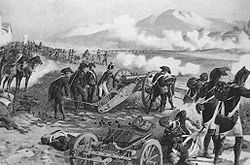
French cannons in activity confronting the Austrians at the Battle of Lodi on 10 May 1796.
At the Battle of Marengo in 1800, Jean Boudet'southward division had four 4-pounders and iv viii-pounders attached to it. The partitioning of Jacques-Antoine de Chambarlhac de Laubespin had at least one four-pounder amongst its 5 guns.[24] While the chief of staff Louis-Alexandre Berthier asserted that Gaspard Amédée Gardanne's partition was equipped with two captured 3-pounders, Gardanne reported that he had two 4-pounders during the boxing.[25]
For the War of the Fourth Coalition in 1806, Napoleon's Grand Army marched to war with the following numbers of 4-pounders in each corps organization. The Imperial Guard counted 14 4-pounders out of a total of 42 pieces, the 3 Corps had 11 of 46 guns, 5 Corps had two of 38 pieces, Vi Corps had four of 24 guns and Vii Corps had 8 of 36 guns. The I Corps, Four Corps and Reserve Cavalry Corps had no 4-pounders in their artillery batteries; the lite cannons existence replaced by 6-pounders.[26]
The 4-pounder was still being used during the War of the Fifth Coalition in 1809. In the Two Corps the quaternary Visitor of the 7th Artillery Regiment employed 6 4-pounders and 2 eight-pounders, the 8th Company of the 5th Artillery had six iv-pounders and ii half dozen-inch howitzers and the 5th Company of the third Artillery had two 4-pounders, four eight-pounders and ii 5½-inch howitzers. The first two companies were attached to the 1st and 2d Infantry Divisions while the third company formed part of the corps reserve. In the III Corps, the infantry divisions each had a company of horse artillery fastened. The 1st Division company had four 4-pounders, the 3rd Division visitor had six iv-pounders and the quaternary Sectionalization company had ii 4-pounders and v vi-pounders.[27] In the Regular army of Italy horse artillery companies were organized with 4 four-pounders and 2 6-inch howitzers. These companies were attached to the divisions of Jean Mathieu Seras, Jean-Baptiste Broussier, Paul Grenier, Gabriel Barbou des Courières, Jean Maximilien Lamarque, Louis Michel Antoine Sahuc and Emmanuel Grouchy. Four other divisions had companies armed with 6-pounders.[28]
At the Battle of Talavera in 1809, the British captured 13 and the Spanish captured 4 French guns from Jean François Leval'due south division. The British prizes included 4 eight-pounders, four 6-pounders, 1 4-pounder and ii 6-inch howitzers. The other captured pieces were non recorded. All but two of the guns were soon recovered by the French at the Battle of Arzobispo.[29]
Notes
- ↑ ane.0 1.1 Chartrand & Hutchins 2003, p. 7.
- ↑ 2.0 2.1 Rothenberg 1980, p. 26.
- ↑ Duparcq & Delabarre-Duparcq 1863, p. 145.
- ↑ Chartrand & Hutchins 2003, p. 14.
- ↑ Chartrand & Hutchins 2003, p. 4.
- ↑ 6.0 6.1 Chandler 1966, p. 360.
- ↑ 7.0 7.one Bowden & Tarbox 1980, p. 35.
- ↑ Duparcq & Delabarre-Duparcq 1863, pp. 146–147.
- ↑ 9.0 9.1 Pivka 1979, p. 32.
- ↑ 10.0 10.1 10.2 10.3 Chandler 1966, p. 359.
- ↑ Pivka 1979, pp. 34–35.
- ↑ Pivka 1979, p. 37.
- ↑ thirteen.0 13.1 Rothenberg 1980, p. 74.
- ↑ Chartrand & Hutchins 2003, p. 2.
- ↑ 15.0 xv.ane Pivka 1979, p. 21.
- ↑ Pivka 1979, p. 23.
- ↑ Chandler 1966, p. 358.
- ↑ 18.0 18.one Pivka 1979, p. 29.
- ↑ Rothenberg 1980, pp. 78–79.
- ↑ Rothenberg 1980, p. 75.
- ↑ Pivka 1979, pp. 49–50.
- ↑ 22.0 22.1 Pivka 1979, p. 51.
- ↑ Rothenberg 1980, pp. 76–78.
- ↑ Arnold 2005, pp. 270–271.
- ↑ Arnold 2005, p. 184.
- ↑ Chandler 2005, pp. 34–37.
- ↑ Bowden & Tarbox 1980, pp. 56–58.
- ↑ Bowden & Tarbox 1980, pp. 101–103.
- ↑ Oman 1995, pp. 536–538.
References
- Arnold, James R. (2005). Marengo & Hohenlinden: Napoleon's Rise to Power. Barnsley, South Yorkshire: Pen and Sword. ISBN 1-84415-279-0.
- Bowden, Scotty; Tarbox, Charlie (1980). Armies on the Danube 1809. Arlington, Texas: Empire Games Press.
- Chandler, David G. (1966). The Campaigns of Napoleon. New York, N.Y.: Macmillan.
- Chandler, David G. (2005). Jena 1806: Napoleon Destroys Prussia. Westport, Conn.: Praeger Publishers. ISBN 0-275-98612-8.
- Chartrand, René; Hutchins, Ray (2003). Napoleon's Guns, 1792-1815. Oxford, Britain: Osprey Publishing. http://books.google.com/books?id=hb7DHfs8aZ4C&pg=PA14&dq=Valliere+system.
- Duparcq, Édouard La Barre; Delabarre-Duparcq, Nicolas Édouard (1863). "Elements of Military Art and History". New York, Northward.Y.: D. Van Nostrand. https://books.google.com/books?id=1mYaAAAAYAAJ&; . Retrieved xi November 2015.
- Oman, Charles (1995). A History of the Peninsular War Volume Two. Mechanicsburg, Pennsylvania: Stackpole. ISBN ane-85367-215-7.
- Pivka, Otto von (1979). Armies of the Napoleonic Era. New York, N.Y.: Taplinger Publishing. ISBN 0-8008-5471-three.
- Rothenberg, Gunther E. (1980). The Art of State of war in the Historic period of Napoleon. Bloomington, Ind.: Indiana University Press. ISBN 0-253-31076-eight.
External links
This website is useful for converting Erstwhile French pounds (livres) into English language pounds and metric equivalents. Information technology can also convert Quondam French inches (pouces) into English inches.
- Gershtein, Sergey; Gershtein, Anna (2013). "Livre Conversion Chart (Weight and Mass Converter, Onetime French)". http://world wide web.catechumen-me.com/en/convert/weight/flivre.html . Retrieved six November 2015.
Source: https://military-history.fandom.com/wiki/Canon_de_4_Gribeauval

Post a Comment for "Brown Art 16 French Gribeauval 12pounder Cannon in Stock"